Explanation
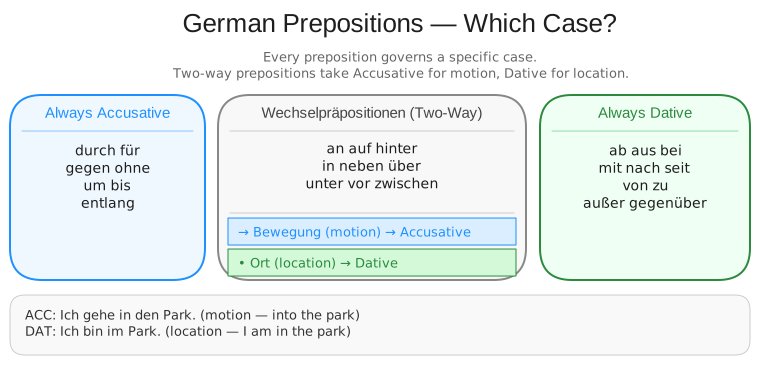
Prepositions are short words that link a noun or pronoun to the rest of the sentence, indicating direction, location, time, or manner. In German, every preposition governs a specific case — the noun or pronoun that follows must take the correct case ending.
Rules
Accusative Prepositions (always accusative)
durch, für, gegen, ohne, um, bis, entlang
| Example | Translation |
|---|---|
| Er kauft es für den Mann. | He buys it for the man. |
| Wir gehen durch den Park. | We walk through the park. |
| Sie läuft um den See. | She runs around the lake. |
Dative Prepositions (always dative)
ab, aus, bei, mit, nach, seit, von, zu, gegenüber, außer
| Example | Translation |
|---|---|
| Ich fahre mit dem Bus. | I travel by bus. |
| Er kommt aus der Stadt. | He comes from the city. |
| Sie wohnt bei ihrer Mutter. | She lives with her mother. |
Two-Way Prepositions (accusative or dative)
These prepositions use accusative for movement/direction and dative for location/position:
an, auf, hinter, in, neben, über, unter, vor, zwischen
| Movement (accusative) | Location (dative) |
|---|---|
| Ich lege das Buch auf den Tisch. | Das Buch liegt auf dem Tisch. |
| Er geht in die Schule. | Er ist in der Schule. |
Tip: Ask yourself — is something moving to a place (accusative) or already at a place (dative)?
Genitive Prepositions (formal/written German)
wegen, trotz, während, innerhalb, außerhalb, statt
| Example | Translation |
|---|---|
| Wegen des Wetters bleiben wir drin. | Because of the weather, we stay inside. |
| Trotz des Regens gehe ich spazieren. | Despite the rain, I go for a walk. |
Examples
- Das Geschenk ist für dich. — The gift is for you. (accusative)
- Ich bin seit einem Jahr in Berlin. — I’ve been in Berlin for a year. (dative)
- Der Hund liegt unter dem Tisch. — The dog is lying under the table. (dative — location)
- Der Hund läuft unter den Tisch. — The dog runs under the table. (accusative — movement)
Related Vocabulary
Exceptions
- Entlang can follow the noun instead of preceding it: den Fluss entlang
- In spoken German, wegen/trotz are often used with dative instead of genitive: wegen dem Wetter
Notes
Two-way prepositions are one of the most important (and tricky) areas of German grammar. See Accusative Case, Dative Case, Genitive Case, German Cases.
Resources
- Master German Prepositions - Top 10 Dative Prepositions You Must Know — YourGermanTeacher · all 10 dative prepositions with examples
- Dative Prepositions - German — sentence theme: 2 example sentences per preposition
- Stop Confusing seit seit & seitdem - German A2 & B1 — YourGermanTeacher · seit as preposition vs conjunction vs adverb