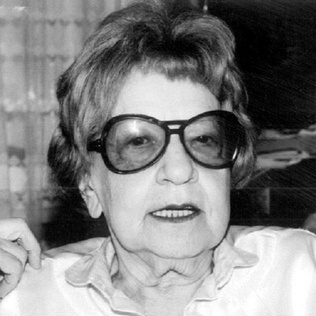
Bio
Kató Lomb (8 February 1909 – 9 June 2003) was a Hungarian interpreter, translator, and one of the first simultaneous interpreters in the world. Originally trained in chemistry and physics, she became fascinated by languages as an adult — legend has it she began teaching herself Russian from a grammar book while sheltering from Soviet artillery advancing on Budapest in WWII.
She worked professionally in 16 languages (Bulgarian, Chinese, Danish, English, French, German, Hebrew, Italian, Japanese, Latin, Polish, Romanian, Russian, Slovak, Spanish, and Ukrainian), all learned through self-study. She claimed reading comprehension in at least 28 languages and could interpret in 10. Almost all of this was achieved as an adult — making her one of the most compelling real-world refutations of the “too old to learn languages” myth.
Her approach predated the modern comprehensible input movement but aligns almost perfectly with it: extensive reading in real texts, minimal grammar drilling, tolerating ambiguity, and prioritizing exposure volume over precision.
Works
Books
- Polyglot - How I Learn Languages (1970) — her landmark work; anecdotes and reflections on language learning methodology; translated into English and widely cited in the polyglot community
- Nyelvekről jut eszembe - Kató Lomb (1983) — “Languages Remind Me…”; cultural and anecdotal reflections; primarily in Hungarian
- Bábeli harmónia - Kató Lomb (1988) — “Harmony of Babel”; interviews with famous multilingual Europeans; primarily in Hungarian
Films & TV
Music
Other
Lomb’s Reading Method:
- Use a novel as the centerpiece of study — something compelling enough to keep you reading
- Read without stopping for every unknown word; build tolerance for ambiguity
- Only look up words that keep reappearing and seem essential to understanding
- Prioritize volume of exposure over precision of comprehension at each sitting
Notes
The Lomb Formula:
Result = (Time × Interest) / Inhibition
The denominator — inhibition — is the part most people overlook. Fear of sounding foolish, perfectionism, reluctance to produce before feeling ready: these actively slow acquisition. Suppressing inhibition is a learnable skill, not a personality trait.
Key quotes:
- “Language is the only thing worth knowing even poorly.”
- “The time spent on language learning is lost unless it reaches a certain—daily and weekly—concentration.”
- “Self-assurance, motivation, and a good method play a much more important role in language learning than the vague concept of innate ability.”
- “One should connect language learning with either work or leisure — not at the expense of them, but to supplement them.”
Context:
- Lomb’s method is Krashen’s i+1 hypothesis in practice, arrived at empirically decades before Krashen formalized it
- Steve Kaufmann has cited Lomb as a major influence; her reading-first approach is the philosophical ancestor of LingQ
- Her life is a direct counter-argument to the critical period hypothesis — she acquired most of her languages as an adult, many past age 40
- Connected wiki pages: Comprehensible Input · Language Learning