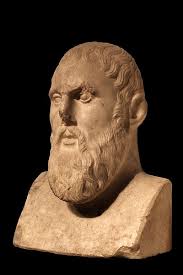
Bio
Zeno of Citium (c. 334–262 BCE) was a Hellenistic philosopher born in Citium, Cyprus (of probable Phoenician descent). He is the founder of Stoicism. After a shipwreck stranded him in Athens around 312 BCE, he began studying philosophy, first under the Cynic philosopher Crates of Thebes, then under Stilpo and Polemo. Around 301 BCE he began teaching his own philosophy at the Stoa Poikile (the “Painted Porch”) in the Agora — which gave Stoicism its name.
None of Zeno’s writings survive intact; what we know of his thought comes through later sources, primarily Diogenes Laërtius’s Lives of the Eminent Philosophers. Despite this, he is credited with the foundational framework of Stoic philosophy: the division of philosophy into logic, physics, and ethics; the concept of logos (rational order); and the identification of virtue as the only true good.
His school attracted students from across the Greek world and eventually rivaled the Academy (Plato’s school) and the Lyceum (Aristotle’s school) in influence.
Works
Books
(No surviving works — known through secondary sources)
- On Life According to Nature — title known; content reconstructed through later Stoic writers
- Republic — a political philosophy work, reportedly influenced by Plato’s Republic but arguing for a world community based on reason rather than city-states
Films & TV
Music
Other
Notes
- The name “Stoicism” comes from the Stoa Poikile — the painted colonnade where Zeno taught. He never intended the name; it was assigned by others.
- His own philosophical journey illustrates Stoic themes: a shipwreck (loss of external goods) led him to philosophy. He reportedly said it was the most fortunate voyage of his life.
- Zeno bridged the Cynic tradition (radical indifference to external goods) with a more socially engaged, systematically reasoned philosophy — making Stoicism liveable in a way pure Cynicism was not.
- His successor as head of the school was Cleanthes, followed by Chrysippus — who systematized Stoic logic and is often credited with shaping the doctrine into its mature form.