Explanation
Declension is how articles, pronouns, and adjectives change their endings depending on the case (grammatical role) and gender of the noun they accompany. This note is a reference grid — use it when you need to quickly look up the correct form of an article.
For what each case means, see the individual case notes: Nominative Case, Accusative Case, Dative Case.
Quick Reference — The Signal Endings
Every case/gender combination is signalled by one of five letters. Once you recognise the letter, you know the case and gender:
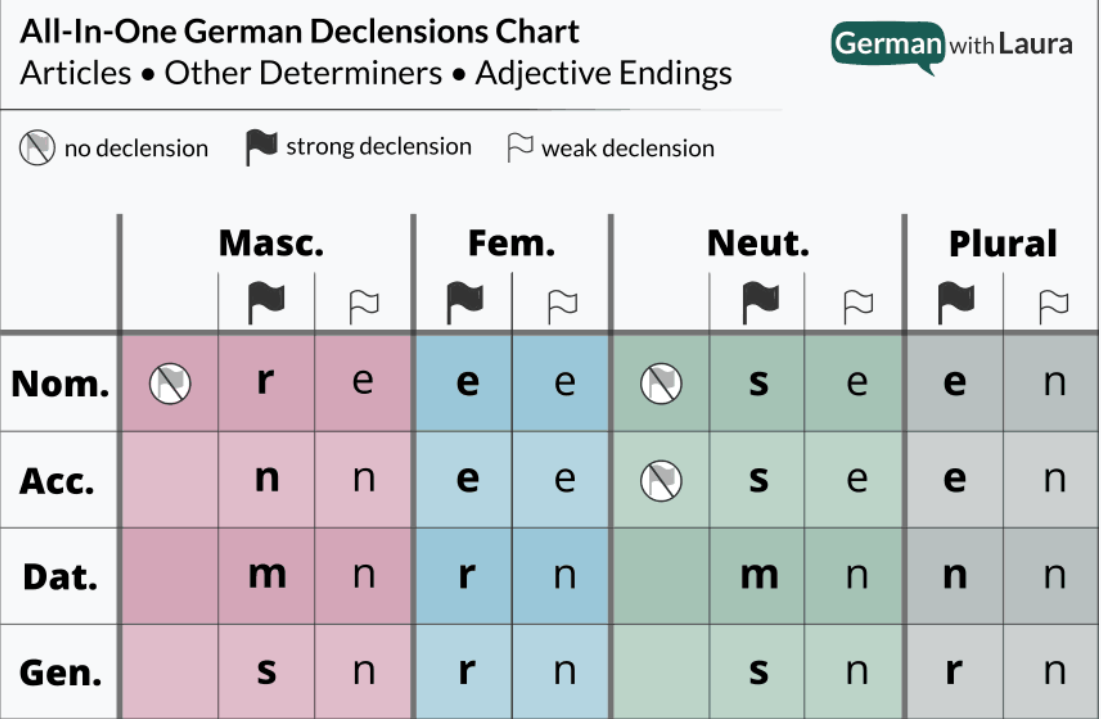
| Masculine | Feminine | Neuter | Plural | |
|---|---|---|---|---|
| Nominative | -r | -e | -s | -e |
| Accusative | -n | -e | -s | -e |
| Dative | -m | -r | -m | -n |
| Genitive | -s | -r | -s | -r |
Bold = cells that differ from the row above.
These endings appear on whichever word carries the declension — usually the article (der, die, das, den, dem, des), or the adjective if there is no article.
The three ein-word gaps ⚠️
Ein/eine/ein fails to show a clear signal ending in three cells — these are the spots most likely to cause errors:
| Cell | ein-word form | Problem |
|---|---|---|
| Masculine Nominative | ein | No -r ending — looks identical to neuter |
| Neuter Nominative | ein | No -s ending — looks identical to masculine |
| Neuter Accusative | ein | No -s ending — same issue |
In these three spots, if there is an adjective, it must carry the strong ending instead: ein alter Mann (an old man), ein kleines Kind (a small child).
Rules
Definite Article — der/die/das (the)
| Case | Masculine | Feminine | Neuter | Plural |
|---|---|---|---|---|
| Nominative | der | die | das | die |
| Accusative | den | die | das | die |
| Dative | dem | der | dem | den |
| Genitive | des | der | des | der |
Bold = forms that differ from nominative. The feminine and neuter accusative stay the same — only masculine changes (der → den).
Indefinite Article — ein/eine (a/an)
| Case | Masculine | Feminine | Neuter | Plural |
|---|---|---|---|---|
| Nominative | ein | eine | ein | — |
| Accusative | einen | eine | ein | — |
| Dative | einem | einer | einem | — |
| Genitive | eines | einer | eines | — |
Plural has no indefinite article. For plural indefinite, use no article: Ich sehe Hunde. (I see dogs.)
Negative Article — kein/keine (no / not a)
Kein follows the same endings as ein, but works for all genders and the plural:
| Case | Masculine | Feminine | Neuter | Plural |
|---|---|---|---|---|
| Nominative | kein | keine | kein | keine |
| Accusative | keinen | keine | kein | keine |
| Dative | keinem | keiner | keinem | keinen |
| Genitive | keines | keiner | keines | keiner |
Noun Endings by Case
Nouns themselves rarely change form — the article does most of the work. The main exceptions:
| Case | Change | Example |
|---|---|---|
| Dative plural | Add -n to the plural (if it doesn’t already end in -n or -s) | die Hunde → den Hunden |
| Genitive masculine/neuter | Add -s or -es to the noun | des Hundes, des Hauses |
Examples
- Der Hund ist groß. — The dog is big. (nominative masculine)
- Ich sehe den Hund. — I see the dog. (accusative masculine → der becomes den)
- Ich gebe dem Hund Wasser. — I give the dog water. (dative masculine)
- Ich wohne in der Stadt. — I live in the city. (dative feminine → die becomes der)
- Er hat keinen Freund hier. — He has no friend here. (accusative masculine kein)
Related Vocabulary
- der Hund — masculine noun; see all four cases in its declension table
- die Stadt — feminine noun
- das Haus — neuter noun
- der Freund — masculine noun
Notes
Adjective endings follow a similar pattern to articles and will be covered in a separate note (Adjective Declension) at B1. For now, focus on getting article endings solid — they are the foundation everything else builds on.