Explanation
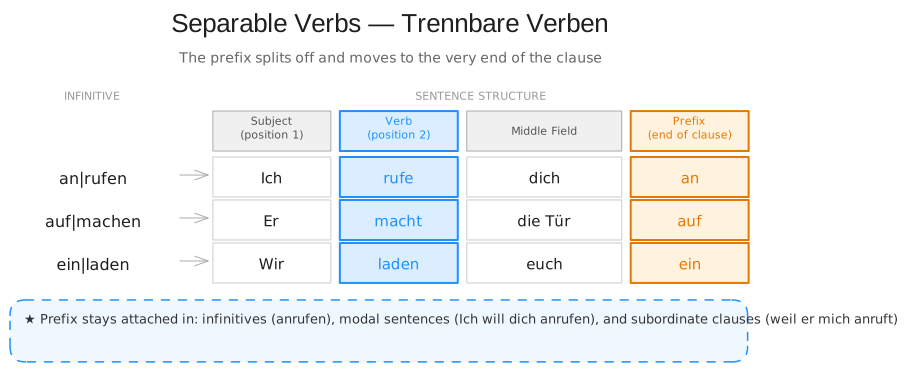
Separable verbs (trennbare Verben) are verbs with a detachable prefix. In a main clause, the prefix splits off and moves to the very end of the sentence. The base verb still conjugates normally in second position.
Ich rufe dich später an. — I’ll call you later.
The infinitive form (as listed in the dictionary) keeps the prefix attached: anrufen, aufmachen, einladen.
Rules
1. Present tense — prefix goes to the end
| Infinitive | Sentence |
|---|---|
| anrufen | Ich rufe dich an. |
| aufmachen | Er macht die Tür auf. |
| einladen | Wir laden euch ein. |
2. Infinitive — prefix stays attached (e.g. with modals)
Ich möchte dich anrufen. — I would like to call you. Kannst du die Tür aufmachen? — Can you open the door?
3. Perfekt — ge- inserts between prefix and stem
anrufen → angerufen — Ich habe dich angerufen. (I called you.) aufmachen → aufgemacht — Er hat die Tür aufgemacht. (He opened the door.)
4. Subordinate clause — prefix stays attached, whole verb goes to end
…, weil ich dich anrufe. — …, because I’m calling you. …, weil er die Tür aufmacht. — …, because he’s opening the door.
Common separable prefixes
| Prefix | Meaning hint | Example |
|---|---|---|
| an- | toward, starting | anrufen (to call), ankommen (to arrive) |
| auf- | up, open | aufmachen (to open), aufstehen (to get up) |
| ab- | off, away | abfahren (to depart), abnehmen (to lose weight) |
| aus- | out | ausgehen (to go out), ausziehen (to move out) |
| ein- | in, into | einladen (to invite), einkaufen (to shop) |
| mit- | with, along | mitkommen (to come along), mitnehmen (to take along) |
| vor- | before, forward | vorstellen (to introduce), vorhaben (to plan) |
| zurück- | back | zurückkommen (to come back) |
| zu- | shut, closed | zumachen (to close) |
| weg- | away | weggehen (to go away), wegfahren (to drive away) |
Examples
- Ich rufe dich später an. — I’ll call you later. (→ anrufen)
- Wann kommt der Zug an? — When does the train arrive?
- Sie lädt ihre Freunde ein. — She’s inviting her friends.
- Er steht jeden Morgen früh auf. — He gets up early every morning.
- Ich habe dich dreimal angerufen. — I called you three times. (Perfekt)
- …, weil sie morgen ankommt. — …, because she’s arriving tomorrow. (subordinate)
Related Vocabulary
- anrufen — to call (phone) — the core separable verb from our Satzsammlung
- gehen — pairs with separable prefixes: ausgehen (go out), weggehen (go away)
- kommen — pairs with separable prefixes: ankommen (arrive), zurückkommen (come back)
Exceptions
Not all prefixes are always separable. Some prefixes (be-, ge-, er-, ver-, ent-, zer-) are inseparable — the prefix never splits off and no ge- is added in Perfekt:
verstehen (to understand) → Ich verstehe das. / Ich habe das verstanden.
When in doubt, check the dictionary — separable verbs are marked with a dot or vertical bar: an|rufen.
Notes
The prefix jumping to the end is one of the first things that surprises English speakers — but it follows a strict rule. Think of it like the verb “calling up” in English being split as “I’ll call you up later.” Same idea, just more consistent in German.
See also Word Order for how this interacts with the V2 rule.
Resources
- 50 Must-Know German Separable Verbs - A1 - B1 — YourGermanTeacher · 50 essential separable verbs with examples, A1–B1